
Ryegrass Seeding Density
Calculating seeding density is a means of fine-tuning to target ideal pasture composition for mixed swards, and also provide an opportunity for the recruitment of companion species. Calculation of an ideal sowing rate for a particular circumstance may allow you to potentially save on an area of input costs and yet also readily meet production targets.
Standard sowing rates of ryegrasses are commonly in the ranges of 20-25kg/ha for diploids and 25-35kg/ha for tetraploids.
Whilst these rates are highly reliable to produce a good ryegrass dominant pasture, variations in seed size offer the opportunity to refine sowing rates to achieve viable pastures and potentially save costs, depending on the choices available and your objectives.
Potential benefits of varying the sowing rate
Higher sowing rates:
| Lower sowing rates:
|
Considerations for calculation of sowing rates
In order to determine a target sowing rate, we need to know some facts and make some judgements and reasonable assumptions.
A sowing rate can be calculated using the equation:

Variations of seed size within a unique variety may stem from many sources including:
- General growing conditions and how the grass seed crop “finished”
- Harvest timing and physiological age of the seed
- Harvester settings including threshing, wind, sieve settings etc
- Seed cleaning system: de-awning efficiency, screen types and indent settings, weed seed types in the crop that may only be cleaned by ‘losing’ the smaller or larger seeds etc.
- Finished seed line may have higher proportion of or longer awns (larger/lighter) or, bare kernel seed (smaller/heavier)
- Variation in the seed lot itself due to differences in the paddock or from physical properties (flow etc) through handling, storage and transport.
Target plant density
Determining a target plant density for high performance ryegrass is largely based on some broad recommendations.
Information from Dairy NZ, New Zealand1 suggests 4-million plants per hectare as a good target to establish that may require up to 9-million seeds to be sown.
Alberta, Canada department of Agriculture2 suggest 400-600 plants per square metre.
A full stand of ryegrass achieved through establishing around 400 plants/m2 is well supported by practical evidence of commercial sowing rates.
Also consider the seeder row-spacing (if drilling) as wider row-spacing may crowd seedlings within the row at the same rate of seed per hectare.
A drill with 125mm (5”) row spacing, will have 8m of rows per square meter. At 400 established seedlings per m2, this equates to an average of one established plant per 2cm of row.
Where the ryegrass may be a partner species in a mixed sward with other grasses, clovers, or other companion species, consider proportioning the seeding rate accordingly. Often this will be at around 40% of a full-stand, mono-culture rate, say 160 plants/m2 or 1 plant per 5cm of drill row.
Germination
Barenbrug proprietary ryegrass seed normally meets a minimum 90% germination rate, and the industry standard is 85%. Poorly produced or badly stored older seed may have reduced germination. Seed tests are available on request. Lower germination seed will require proportionally higher sowing rates to achieve plant density targets.
Field factors
Field factor is a generic term that may also be described as the inverse of establishment %, and takes into account a judgement for seed or seedling losses. Potential in-field challenges to newly sown seeds are numerous, and the following may describe some of the most common considerations.
If planting conditions are ideal with minimal crop challenges anticipated, then sowing rates may be reduced accordingly.
Also consider the opportunity cost of lost time, seed and re-drilling should establishment be unsatisfactory. Increasing the sowing rate to allow for a potential loss of seed or seedlings is warranted in many cases. If field factors are significant, then where possible, they should be addressed prior to sowing.
- Paddock preparation and presentation issues including clods, trash, turf-matting etc
- Possible residual herbicide challenges
- Variation in sowing depth from undulations, equipment issues, slope etc
- Issues with furrow closure, soil-seed contact and variable moisture availability
- Incorrect or variable seeder calibration, or inefficiencies from seed spreader operations
- Seed or seedling fertiliser burn / desiccation
- Post-sowing challenges such as wind or water erosion, soil slumping, surface slaking/sealing
- Variation in soil types, drainage, slope, and aspectwithin a paddock
- Seed predation by birds, ants etc
- Seedling loss to pests such as mites, slugs, snails, false wire-worm etc.
Oversowing
If oversowing an existing pasture, allow for the plant density and vigour of the existing sward. Reducing the cover through tight grazing, a knock-down herbicide or a desiccant herbicide may be required to assist the newly sown seedlings to compete and establish.
Oversowing rates into an existing ryegrass pasture are typically 50-75% of the respective full sowing rate depending assessing the residual plant density. In situations where kikuyu or couch is being oversown, the field factor may need to be increased to 50-60%, thus anticipating only 40% or so establishment. This may require a sowing rate of 2-3 times higher than compared to a prepared paddock:
e.g.
Hogan sown into a bare paddock, well prepared: 25kg/ha
Hogan oversown into kikuyu: 50-60kg/ha
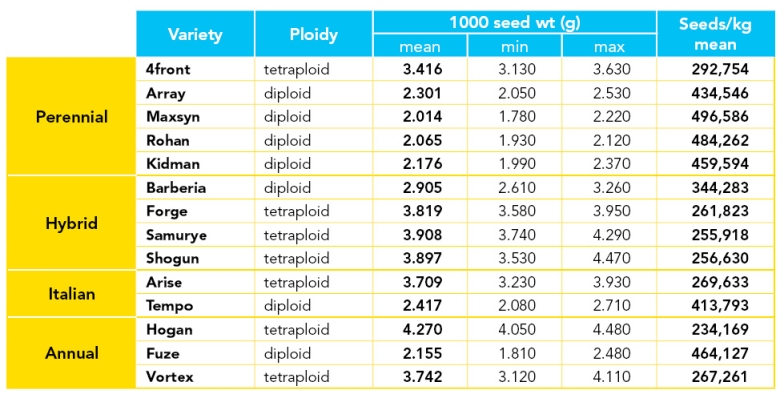
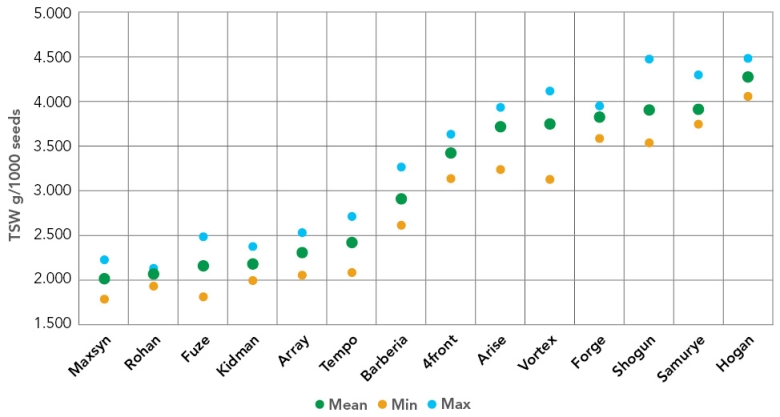
Thousand seed weights of Barenbrug ryegrasses
A 2024 survey of three lines of each variety of ryegrass has reported the following information on seed size, and variation within varieties:
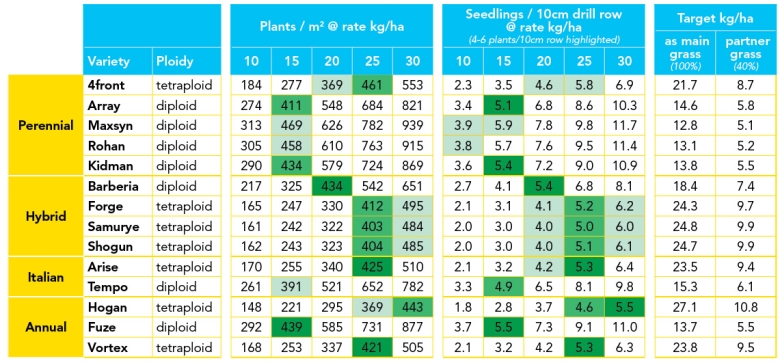
Plant density effects from seed sizes and sowing rates
Assumptions:
Germination: 90%
Establishment (field factor):70%,30% lost to field factors
Drill row width (mm): 125mm
Target density as main grass - 100% rate (n/m2): 400/m2, 2.0cm average spacing per established seedling
Target density as a partner grass - 40% rate (n/m2):160/m2
Reasonable paddock preparation and not oversowing kikuyu etc.
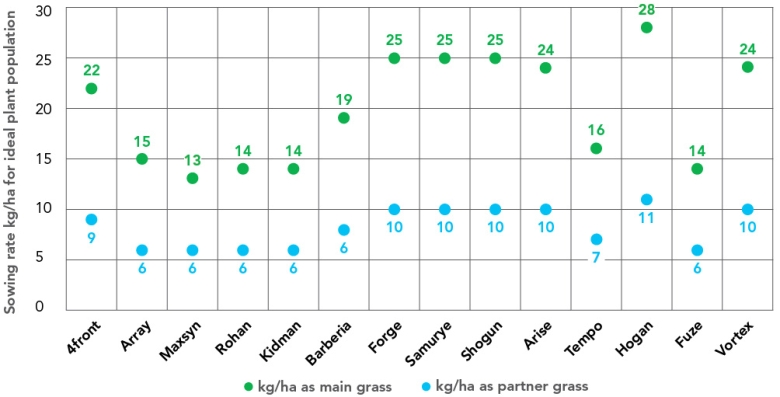
Recommended sowing rates for Barenbrug Ryegrasses
(90% germination, 30% field factor)
References:
1 https://www.dairynz.co.nz/feed/pasture-species/ryegrass/
2 https://www.agric.gov.ab.ca/app19/calc/forageseed/seedingtable.html